
Every few months, another article declares that physical marketing is dead. Print is dead. Storefront signage is dead. Branded apparel is dead. And every few months, the businesses that actually generate foot traffic, build local recognition, and turn strangers into loyal customers prove those articles wrong in the most practical way possible — by existing visibly in the real world.
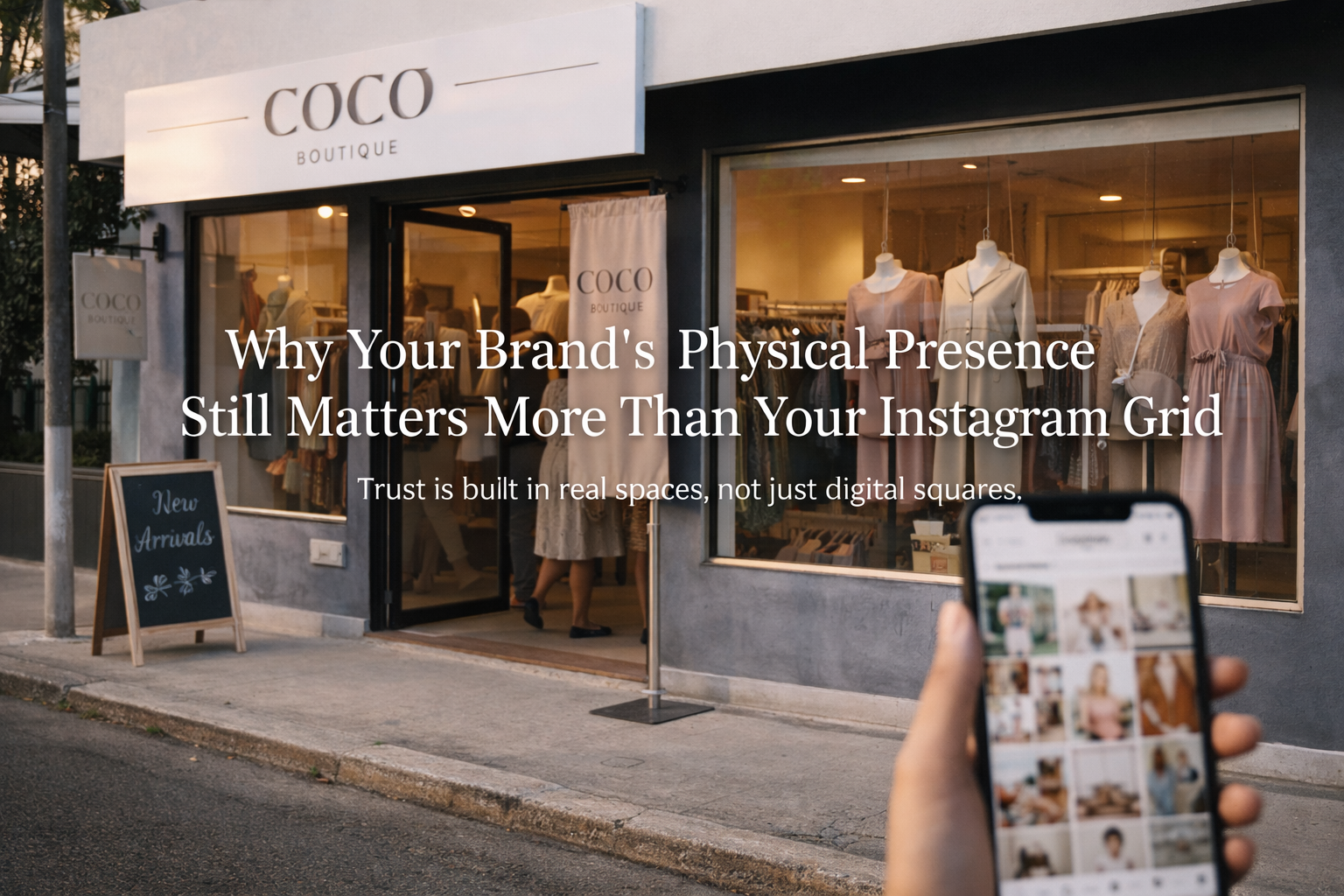
Here is the truth that digital-first marketers rarely say out loud: people still trust what they can see with their eyes and touch with their hands. A well-designed banner outside a storefront communicates legitimacy in about two seconds. A branded shirt worn by someone at a community event sparks a conversation that no Instagram ad can replicate. A clean, professional label on a product makes the item feel worth the price before the customer has even opened it.
Physical branding is not a backup plan for businesses that haven’t figured out digital marketing. It’s a parallel channel — and for many businesses, it’s the one that closes the most sales.
The Problem with Being Invisible in Physical Space
Think about the last time you drove past a strip mall or walked down a commercial block. You probably don’t remember every storefront. But you almost certainly remember the ones with strong visual presence — the bold banner announcing a grand opening, the clean rigid sign with a memorable logo, the staff wearing matching branded tees that made the business look like it had its act together.
That’s not an accident. It’s the result of intentional investment in physical visibility.
The businesses that skip this step — that rely entirely on their online presence to do the branding work — tend to struggle with one recurring problem: people don’t know they exist until they’re actively searching for them. And by the time someone is actively searching, they already have three competitors lined up in the results. Physical branding catches people who weren’t looking. That’s a different kind of marketing, and a more powerful one in many contexts.
A restaurant that puts a well-designed vinyl banner in its window announcing a weekend special will capture attention from the hundreds of people who walk past that window every day — most of whom were not searching for a restaurant at that moment, but who might just decide they are now. That’s not a use case for a Facebook ad. That’s a use case for a banner.
Custom Banners: The Most Versatile Piece of Physical Marketing You Can Own
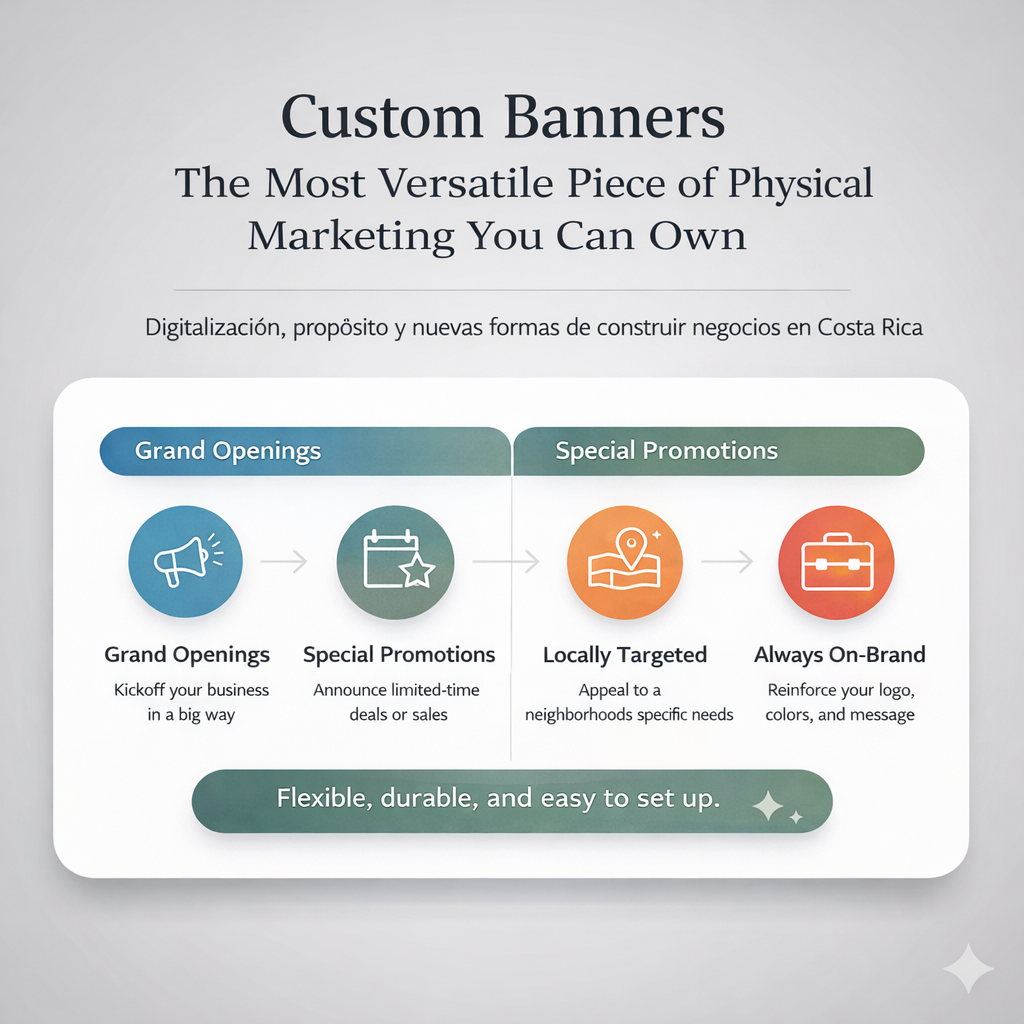
Banners are underestimated. People think of them as temporary, event-specific items — something you put up for a grand opening and then roll into a closet. That’s a waste of one of the most flexible marketing assets available to a small or mid-size business.
A quality vinyl banner, printed on durable material with UV-resistant inks, can last for years outdoors. The same banner that announces your seasonal sale in November can be stored properly — rolled, not folded, kept in a dry space — and reused across multiple seasons. Businesses that invest in well-designed banners with evergreen messaging (“Family Owned Since 2008” or “Now Accepting New Clients”) get years of value from a single print run.
The range of applications is genuinely broad: grand openings, trade shows, farmer’s markets, community events, storefronts, vehicle displays, event backdrops, sports sponsorships, school fundraisers, real estate listings. For any business that participates in physical spaces — which is most businesses — a banner is not a one-time purchase. It’s infrastructure.
Rigid Signs: Communicating Permanence and Professionalism
There’s a psychological difference between a business with a banner and a business with a rigid sign. Both communicate information. But a rigid sign — whether mounted on a post, attached to a wall, or displayed as a sandwich board on the sidewalk — communicates something the banner alone cannot: permanence.
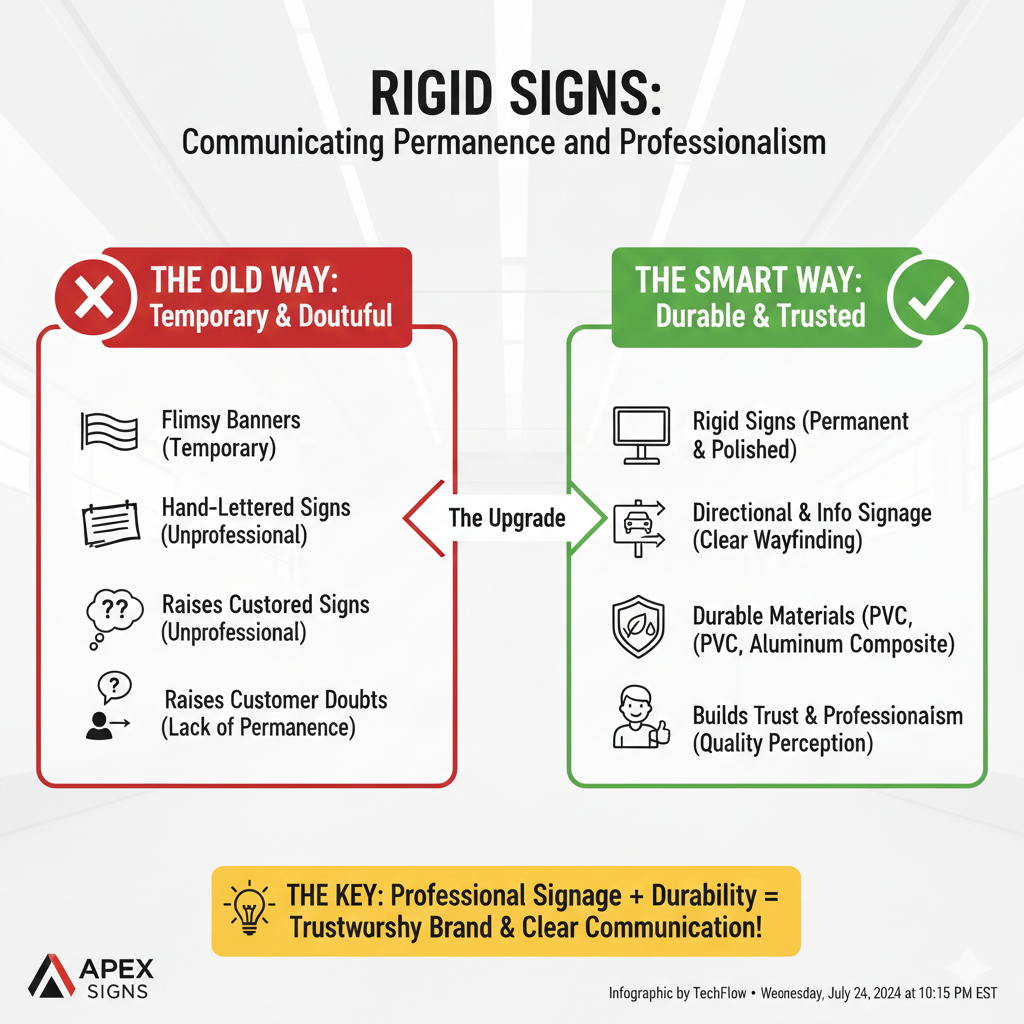
This matters more than most business owners realize. Customers are constantly, often unconsciously, assessing whether a business will be around long enough to honor its commitments. A flimsy or hand-lettered sign raises doubts. A clean, professionally printed rigid sign on quality substrate removes those doubts before the customer even walks through the door.
Rigid signs are also the right choice for directional and informational signage: parking instructions, service menus, wayfinding inside a facility, safety notices. These are pieces that need to hold up under daily handling and varying weather conditions — which is why material choice matters. PVC board and aluminum composite are both popular substrates for good reason: they’re lightweight enough to be practical but durable enough to serve their purpose for years without looking worn.
Roll Labels: Where Branding Lives at the Product Level
For businesses that sell physical products — food and beverage, cosmetics, candles, artisanal goods, retail merchandise — the label is where the customer’s first impression of quality gets formed. Not the social media post. Not the packaging box. The label, examined in the moment of decision, up close, is where trust gets built or lost.
Roll labels give small product businesses access to the same level of professional presentation that large brands invest in. A clean, high-resolution label with accurate color reproduction, printed on the right material for the application (waterproof for beverages, oil-resistant for food products, clear for a minimalist aesthetic), transforms a homemade or small-batch product into something that looks genuinely retail-ready.
The practical advantage of roll labels over sheet labels is significant for businesses with any volume: faster application, compatibility with most label dispensers, and consistent results across large runs without the handling issues that come with individual label sheets.
Branded Apparel: The Walking Advertisement You Pay for Once
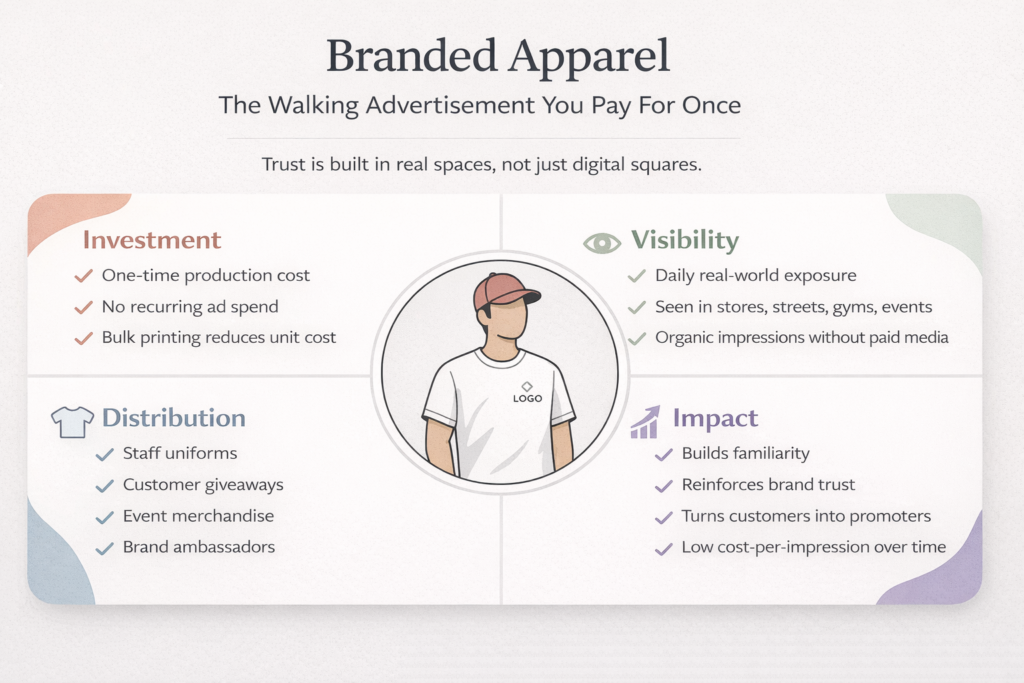
A custom-printed t-shirt is, in terms of cost-per-impression, one of the most efficient marketing investments a small business can make. You pay for it once. Then every time someone wears it — whether that’s a staff member on shift, a loyal customer who got it as a gift, or an event volunteer — the brand gets seen.
This is not a new observation. But the practical implications are worth spelling out for businesses that have been putting off the investment. A cohesive, uniform, or branded apparel line does several things simultaneously: it makes staff easy to identify (improving the customer experience), it communicates professionalism, it turns the people who wear it into walking brand ambassadors, and it creates a sense of team identity that has real internal culture value.
The range of apparel that makes sense for custom printing goes well beyond t-shirts: hoodies for colder months, hats for outdoor operations, polo shirts for more formal service contexts, and custom totes or bags that customers will actually use. Each piece extends the brand into environments and moments that no digital ad can reach.
Getting Your Print Order Right the First Time
The most common source of disappointment in custom printing is not the printer — it’s the file. Artwork submitted at 72 DPI (screen resolution) will print blurry at large formats. Colors set in RGB will shift when converted to CMYK for printing. Fonts not embedded in the file may display differently on the print provider’s system. These are fixable problems, but they’re frustrating when you only discover them after an order is placed.
A few habits that save time and money: always request a print proof before a large run is approved, design at the final output size (not smaller, scaled up), use vector files for logos, and communicate your deadline clearly so the printer can manage the production schedule without rushing in ways that compromise quality.
When comparing print providers for a project, requesting quotes from multiple vendors is a sensible and strategic step. It allows you to assess pricing structures, turnaround times, material quality, and production capabilities before committing.
One practical workflow approach is to use a separate, dedicated email address exclusively for quote requests and initial vendor outreach. This method keeps your communication streamlined, protects your core operational inbox from clutter, and allows you to evaluate vendors efficiently without creating long-term email noise.
The Full-Circle Brand Experience
The most successful businesses — locally rooted or nationally scaled — understand that branding is not a single touchpoint. It’s an accumulation of consistent impressions across every environment where a customer encounters the brand: the storefront sign that makes them stop, the label that makes them pick up the product, the banner that reminds them of an upcoming event, the staff shirt that makes the interaction feel professional.
None of these elements work in isolation. A great banner with a forgettable logo is just colored plastic. A premium label on a poorly designed product creates cognitive dissonance. The power is in the consistency — the sense that every piece of physical communication came from the same intentional place.
A customer rarely interacts with a brand in just one place. They might first notice the storefront sign while walking or driving by. Later, they see a social media post announcing a new collection or event. When they visit in person, they notice the packaging, the labels, the staff uniforms, the way the space is arranged, and even the tone of voice used in conversation. Each of these touchpoints communicates something. Together, they form a narrative.
The key is that none of these elements work effectively in isolation. A beautifully printed banner cannot compensate for a weak visual identity. A premium label applied to a poorly designed product creates confusion rather than trust. A professional-looking storefront paired with inconsistent digital messaging weakens credibility. Customers may not consciously analyze these inconsistencies, but they feel them. And that feeling shapes their perception.
Branding works most powerfully when it is coherent. When the storefront sign makes someone stop because it looks thoughtful and distinct. When the label reinforces that same visual language — same typography, same tone, same level of care. When a banner promoting an event feels like a natural extension of the brand rather than a disconnected announcement. When the staff shirt reflects the same identity, creating a sense of professionalism and belonging.
Consistency does not mean rigidity. It does not mean every element must look identical. It means every element must feel related — intentionally designed as part of a whole. The colors, materials, messaging, and visual cues should align. The emotional tone should remain steady across contexts. The experience of seeing the brand online should match the experience of walking into the physical space.
This alignment builds trust. When customers encounter consistency, they perceive stability and competence. They sense that the business knows who it is. That confidence reduces friction in decision-making. It makes purchasing feel easier and safer. Over time, these consistent impressions accumulate into recognition and loyalty.
The full-circle brand experience also signals respect. It shows that the business has considered the customer’s journey from beginning to end. From the moment attention is captured to the moment the product is used, every detail has been shaped with intention. That intentionality elevates the experience beyond a transaction.